

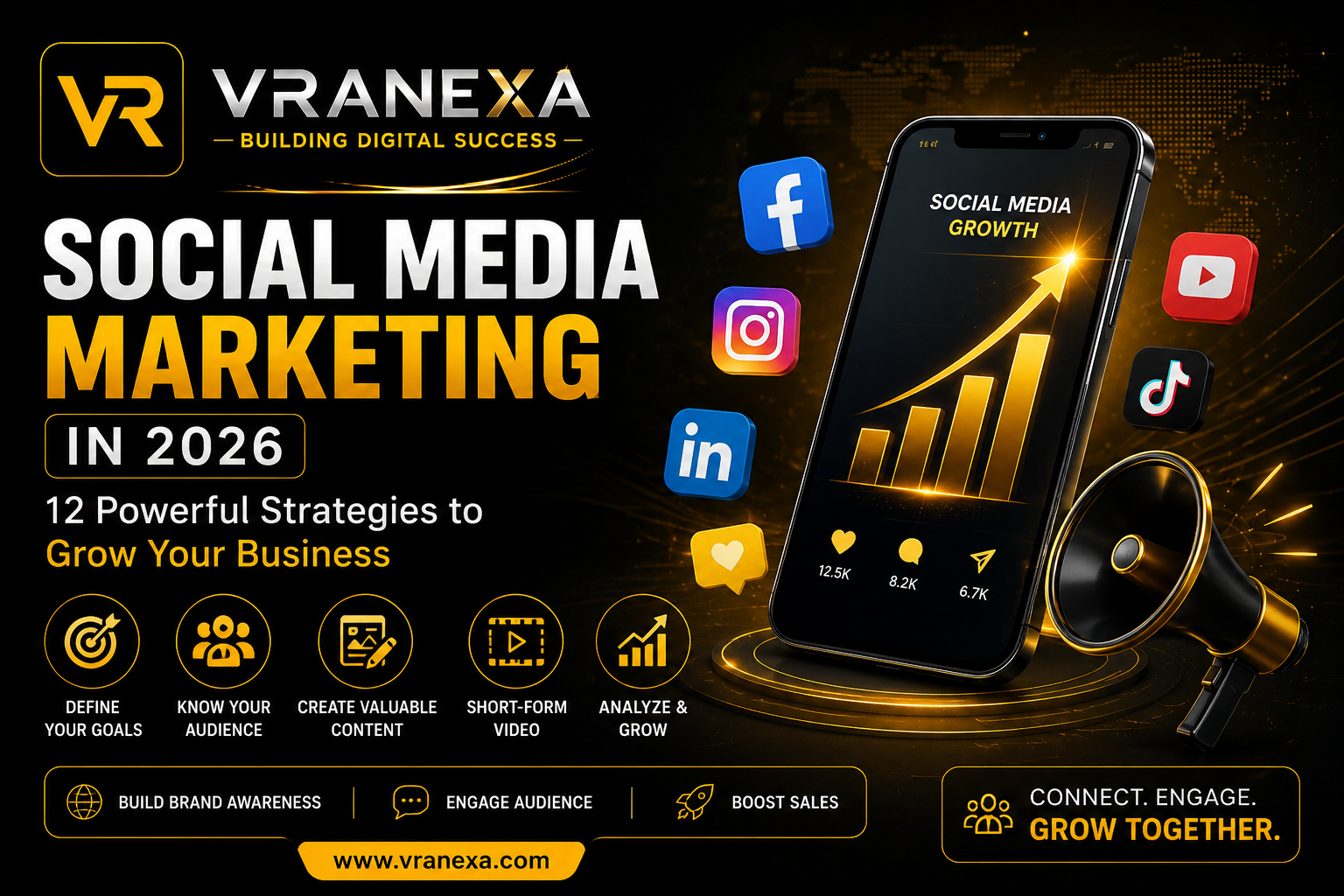
Social media has transformed the way businesses communicate with customers, build brands, generate leads, and sell products or services. Platforms such as Instagram, Facebook, LinkedIn, YouTube, and others have become important digital channels where people discover brands, research businesses, watch content, compare options, and make purchasing decisions.
However, Social Media Marketing in 2026 is no longer simply about posting attractive images every day. Competition for attention is intense. Businesses need a clear strategy that combines valuable content, short-form videos, audience engagement, strong branding, paid advertising, analytics, and increasingly, artificial intelligence.
A successful social media strategy should have a business purpose behind every activity.
Whether you run a startup, local business, e-commerce store, personal brand, or established company, the following 12 Social Media Marketing strategies can help you build a stronger online presence and turn attention into meaningful business growth.
1. Define Clear Social Media Marketing Goals
Before creating content, determine exactly what you want social media to achieve for your business.
Different businesses may have completely different goals.
Your goals could include:
- Increasing brand awareness
- Generating website traffic
- Getting qualified leads
- Increasing product sales
- Growing an online community
- Improving customer engagement
- Building authority
- Promoting new services
- Increasing enquiries
Avoid focusing only on followers.
Having 100,000 followers does not automatically mean you have a successful business. A smaller but relevant audience that regularly engages with your brand and becomes customers can be far more valuable.
For example, a web development company might focus on generating consultation requests, while an e-commerce brand may prioritize product discovery and sales.
Define measurable objectives and connect your social media activity with real business results.
2. Understand Your Target Audience
Successful Social Media Marketing begins with understanding who you want to reach.
Instead of creating content for everyone, identify your ideal customer.
Consider factors such as:
Age: Which age group is most likely to need your product or service?
Location: Are you targeting customers locally, nationally, or internationally?
Interests: What subjects are they interested in?
Problems: What challenges are they currently facing?
Buying intent: What could motivate them to purchase?
For example, a digital marketing agency might target business owners who have a website but struggle to generate traffic or enquiries.
Instead of simply posting:
“We provide SEO services.”
the agency could create content around:
“5 reasons your website is not ranking on Google.”
The second approach addresses an actual customer problem.
When you understand your audience’s problems, your content becomes significantly more relevant.
3. Choose the Right Social Media Platforms
Your business does not necessarily need to be active on every social media platform.
It is usually better to build a strong presence on a few relevant platforms than maintain several inactive accounts.
Different platforms can serve different purposes.
Instagram can be useful for Reels, visual storytelling, brand awareness, portfolios, products, and short educational content.
Facebook can help businesses reach communities, promote content, run advertisements, and maintain a business presence.
LinkedIn is particularly useful for B2B businesses, professional networking, company updates, thought leadership, and lead generation.
YouTube is powerful for tutorials, educational videos, demonstrations, case studies, and long-form content.
Choose platforms based on where your target audience spends time and what type of content your business can consistently produce.
4. Build a Strong and Consistent Brand Identity
People should be able to recognize your brand even before reading your username.
Consistency helps build familiarity and trust.
Maintain a recognizable identity across your content, including:
- Logo
- Typography
- Brand colors
- Graphic style
- Image style
- Tone of voice
- Video presentation
- Calls to action
For example, if your company uses a premium black-and-gold visual identity, your Instagram posts, Reels, story graphics, advertisements, and website can follow the same overall visual direction.
However, consistency does not mean every post should look identical.
Your designs can change while the core brand identity remains recognizable.
The objective is to make someone scrolling through their feed think:
“I know which brand posted this.”
before they even see the account name.
5. Create Valuable Content Instead of Constant Promotion
One of the biggest Social Media Marketing mistakes is turning every post into an advertisement.
If every piece of content says:
“Buy now.”
“Contact us.”
“Get our service.”
people may quickly lose interest.
Instead, create a balanced content strategy.
Your content can include:
Educational Content
Teach your audience something useful.
Examples:
- SEO tips
- Marketing strategies
- Website improvement tips
- Industry insights
- Common mistakes
Problem-Solving Content
Identify a common customer problem and explain how to solve it.
Case Studies
Show how your work helped a business achieve a result.
Behind-the-Scenes Content
Show your team, workflow, design process, or development process.
Promotional Content
Explain your services, offers, products, or packages.
Social Proof
Share genuine customer reviews, testimonials, results, and completed projects.
Useful content gives people a reason to follow your business even when they are not ready to purchase immediately.
6. Make Short-Form Video a Major Part of Your Strategy
Short-form video continues to be an important format for capturing attention on social platforms.
Businesses can use short videos for:
- Quick tips
- Product demonstrations
- Before-and-after transformations
- Website showcases
- Customer testimonials
- Educational content
- Frequently asked questions
- Behind-the-scenes clips
- Brand storytelling
The first few seconds are especially important.
Instead of starting a video with a long introduction, begin with a strong hook.
For example:
“Your website could be losing customers because of these three mistakes.”
This immediately gives viewers a reason to continue watching.
Keep videos focused on one main idea and remove unnecessary information.
Always consider mobile viewers when designing video content.
Vertical formats are particularly important for short-form platforms.
7. Use Strong Calls to Action
Good content captures attention.
A good call to action tells the audience what to do next.
Depending on the goal of the post, your CTA could be:
“Visit our website.”
“Send us a message.”
“Save this post for later.”
“Share this with a business owner.”
“Follow for more marketing tips.”
“Book a consultation.”
“Comment your question below.”
Do not force the same CTA onto every post.
An educational post may encourage users to save or share it, while a service promotion might direct people to a landing page.
The action should naturally match the content.
8. Engage With Your Audience
Social media is not a one-way advertising channel.
Businesses should actively communicate with their audience.
Respond to:
- Comments
- Questions
- Direct messages
- Mentions
- Genuine feedback
If someone asks a useful question in your comments, the answer could even become your next post or video.
Engagement also helps businesses understand what their audience actually cares about.
Pay attention to frequently asked questions.
Those questions can become future:
- Reels
- Blog posts
- FAQs
- Landing pages
- Email content
- Social posts
A strong community can become one of a brand’s most valuable marketing assets.
9. Use Paid Social Media Advertising Strategically
Organic content and paid advertising can work together.
Paid social campaigns can help businesses reach specific audiences faster and promote important offers.
However, simply spending money on ads does not guarantee results.
Before launching a campaign, define:
Objective: What action should the user take?
Audience: Who should see the advertisement?
Creative: What image or video will capture attention?
Offer: Why should someone take action?
Landing page: Where will the advertisement send the visitor?
Tracking: How will results be measured?
For example, sending paid traffic to a slow or confusing website can waste advertising budget.
Your landing page should clearly explain the offer and make the next step easy.
Test different creatives, headlines, audiences, and offers rather than assuming the first campaign will perform perfectly.
10. Use AI to Improve Your Social Media Workflow
Artificial intelligence can help businesses improve efficiency in Social Media Marketing.
AI tools can assist with:
- Content ideas
- Caption drafts
- Video concepts
- Content calendars
- Research
- Script creation
- Design concepts
- Content repurposing
- Performance analysis
For example, one detailed blog article can potentially be transformed into several pieces of social content:
1 Blog → 3 Reels → 5 Instagram posts → LinkedIn content → Short video scripts → FAQ content
This allows businesses to get more value from the research they already performed.
However, AI should support creativity rather than completely replace human judgment.
Generic AI-generated posts without original insight can make a brand feel repetitive.
Review everything before publishing and add your company’s expertise, personality, examples, and experience.
11. Track Social Media Performance
If you are not measuring performance, it becomes difficult to know whether your strategy is actually working.
Important metrics may include:
- Reach
- Impressions
- Engagement
- Video views
- Watch time
- Saves
- Shares
- Profile visits
- Website clicks
- Leads
- Sales
- Conversion rate
Different metrics matter for different objectives.
For example, if your goal is brand awareness, reach and video views may be important.
If your goal is lead generation, website clicks and qualified enquiries matter more.
Do not judge every post only by likes.
A post with fewer likes but several qualified enquiries could be much more valuable than a viral post that generates no customers.
Review performance regularly and identify patterns.
If educational Reels consistently perform better than promotional graphics, produce more high-quality educational videos.
Let data influence future decisions.
12. Build a Long-Term Social Media Strategy
Social Media Marketing rarely produces its maximum potential overnight.
Consistency is important.
Instead of posting heavily for one week and disappearing for a month, create a sustainable publishing schedule.
A simple weekly strategy might include:
- Educational posts
- Short-form videos
- Portfolio or case-study content
- Customer proof
- Industry insights
- Promotional content
- Interactive stories
The exact posting frequency should depend on your resources and audience.
Quality and consistency are generally more useful than publishing large amounts of weak content.
Create a monthly content calendar so your team knows:
What will be posted?
When will it be posted?
Which platform will be used?
What is the objective?
What CTA will be included?
Planning makes your marketing more strategic and less dependent on last-minute ideas.
Common Social Media Marketing Mistakes to Avoid
Businesses often invest time in social media without seeing results because their strategy lacks direction.
Common mistakes include:
- Buying fake followers
- Posting without a clear strategy
- Copying competitors
- Ignoring comments and messages
- Using low-quality visuals
- Posting only promotional content
- Using irrelevant hashtags
- Inconsistent branding
- Focusing only on follower count
- Ignoring analytics
- Sending traffic to poor landing pages
- Expecting immediate results
Fake followers are particularly harmful because they can make account numbers look impressive while providing little real business value.
Focus on building a genuine audience interested in what your business offers.
How Social Media Marketing Helps Businesses Grow
A strong social media presence can support several stages of the customer journey.
A potential customer may first discover your company through a Reel.
Later, they might see an educational post.
Then they may visit your profile and look through your portfolio.
After that, they could visit your website, read customer reviews, and eventually contact your company.
This is why not every social post needs to create an immediate sale.
Social media can build familiarity over time.
When customers eventually need the service you provide, a recognizable and trustworthy brand has a better chance of being considered.
Social Media Marketing and SEO Can Work Together
SEO and social media should not necessarily operate as completely separate strategies.
A business can publish an in-depth article on its website and then transform the main ideas into social media posts and videos.
Social media can introduce people to the content, while search optimization can help the original article gain visibility through search engines.
For example, an article about “12 SEO Strategies for 2026” could become:
- An Instagram carousel
- Three short Reels
- A LinkedIn post
- A YouTube video
- Several story posts
This approach creates a connected digital marketing ecosystem.
Final Thoughts
Social Media Marketing in 2026 is not simply about having an Instagram or Facebook account.
Successful businesses treat social media as a strategic communication and customer-acquisition channel.
Start by understanding your audience. Create useful content that solves real problems. Build a consistent brand identity. Use short-form videos to communicate ideas quickly. Engage with your audience, test paid campaigns carefully, use AI to improve productivity, and measure the results that matter to your business.
Most importantly, stay consistent.
A strong social media presence is built through repeated valuable interactions with the right audience.
Businesses that combine great content + strong branding + video marketing + community engagement + data-driven decisions + conversion-focused websites can turn social attention into meaningful growth.
At VRANEXA, we help businesses strengthen their digital presence through modern web development, Search Engine Optimization, digital marketing, and growth-focused online strategies.
If your business wants to build a stronger online presence, attract the right audience, and turn digital attention into real opportunities, the right Social Media Marketing strategy can be an important part of that journey.
Ready to grow your business online?
Visit VRANEXA and start building your digital success.
Let’s build your high-converting website.
Get a fast, responsive and SEO-ready website designed for real business growth.