
Meta Title:
10 Signs Your Website Needs a Redesign in 2026 | Vranexa
Meta Description:
Is your business website outdated, slow, or failing to generate leads? Discover 10 signs your website needs a redesign and how a modern website can improve SEO, conversions, and business growth.
Featured Image Text:
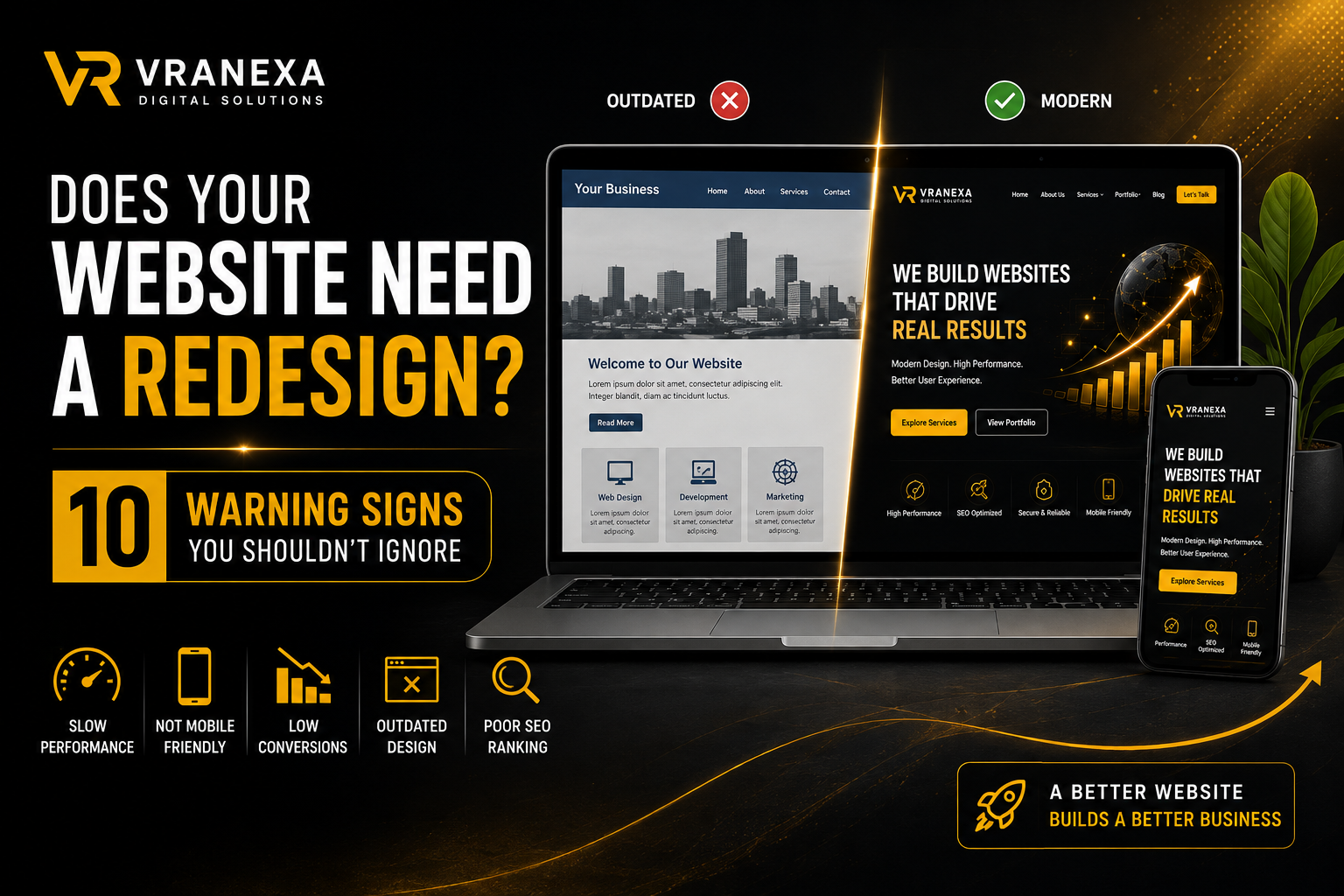
Does Your Website Need a Redesign?
10 Warning Signs You Shouldn’t Ignore
Featured Image idea: Vranexa black + gold branding, laptop showing an outdated website on one side and a premium modern website on the other, upward growth graph, mobile responsive preview, clean professional agency style.
Your website is often the first interaction a potential customer has with your business. Before calling your team, visiting your office, requesting a quote, or purchasing a product, many customers will first check your website.
That means your website is no longer simply an online brochure. It is an important part of your brand, marketing strategy, lead-generation system, and customer experience.
A website that looked modern several years ago may now feel outdated. Technology changes, customer expectations increase, search engines evolve, and competitors continuously improve their digital presence.
If your website is slow, difficult to navigate, poorly optimized for mobile devices, or unable to convert visitors into customers, redesigning it may become necessary.
Here are 10 major signs that your business website may need a redesign.
1. Your Website Looks Outdated
Design trends change quickly.
Visitors can often recognize an outdated website within seconds. Old fonts, crowded layouts, excessive text, outdated graphics, poor spacing, and inconsistent colors can make a business appear less professional.
Your website should visually represent the quality of your company.
A modern website generally uses clean layouts, clear typography, consistent branding, professional imagery, strategic whitespace, and strong calls to action.
The objective is not to redesign a website simply because a particular visual trend has changed. The objective is to ensure that your website still communicates trust, professionalism, and relevance.
If competitors have modern websites while yours looks several years behind, visitors may subconsciously associate that difference with the businesses themselves.
2. Your Website Is Not Mobile-Friendly
Mobile responsiveness is essential.
Customers regularly browse websites using smartphones and tablets. A website designed primarily for desktop screens can create serious usability problems on smaller devices.
Common mobile problems include text that is too small, buttons positioned too closely together, images extending outside the screen, horizontal scrolling, oversized menus, and forms that are difficult to complete.
A responsive website automatically adapts its layout to different screen sizes.
Visitors should be able to navigate, read content, submit forms, browse services, and contact your business comfortably from virtually any modern device.
A redesign provides an opportunity to create the website with a mobile-first approach instead of attempting to patch an outdated desktop layout.
3. Your Website Loads Slowly
Website speed directly affects user experience.
People expect websites to load quickly. When visitors have to wait too long, many will leave before interacting with the page.
Large unoptimized images, excessive plugins, unnecessary JavaScript, poorly written code, outdated themes, weak hosting, and excessive third-party scripts can all reduce website performance.
Website redesign projects should therefore focus on performance as well as appearance.
Images can be compressed and delivered in modern formats, unnecessary scripts can be removed, code can be optimized, caching can be implemented, and the overall page structure can be simplified.
A beautiful website that takes too long to load is still providing a poor experience.
4. Visitors Are Coming but Not Converting
Traffic alone does not make a website successful.
Imagine that hundreds or thousands of people visit your website every month, but very few contact your company, request quotes, purchase products, or book consultations.
The problem may be conversion design.
Visitors need clear guidance about what they should do next.
A high-converting website uses strategically placed calls to action such as:
- Get a Free Quote
- Book a Consultation
- View Our Services
- Start Your Project
- Contact Us
- Request a Demo
These actions should appear naturally throughout the customer journey.
The website should also clearly explain what your company provides, who it helps, why customers should trust it, and how they can get started.
A redesign allows these conversion paths to be planned intentionally.
5. Your Website Is Difficult to Navigate
Good navigation should feel almost invisible.
Visitors should not need to think extensively about where they need to click.
If important information is buried inside confusing menus or users need multiple unnecessary clicks to reach important pages, your website architecture may need improvement.
For many business websites, the primary navigation can remain straightforward:
Home, About Us, Services, Portfolio, Pricing, Blog, and Contact.
Businesses with multiple services can use structured dropdown menus without overwhelming visitors.
The objective is simple: help visitors reach important information as quickly as possible.
6. Your Website Is Not Generating Leads
Your website should contribute to business growth.
If your site receives visitors but produces almost no enquiries, the problem may extend beyond traffic.
Effective lead-generation websites combine strong messaging, professional design, trust signals, clear services, testimonials, case studies, strategically positioned forms, and strong calls to action.
Visitors should understand your offer quickly.
For example, instead of using a generic headline such as:
“Welcome to Our Website”
a stronger message would communicate the actual benefit:
“High-Performance Websites Designed to Turn Visitors Into Customers.”
The second version immediately explains what the company does and why the visitor should care.
7. Updating Website Content Is Difficult
Businesses change constantly.
You may introduce new services, publish articles, update pricing, add projects, replace team members, publish testimonials, or change promotional offers.
If every minor content update requires a developer, your website may not have been built with efficient content management in mind.
Platforms such as WordPress and Shopify can allow businesses to manage large portions of their websites through an administrative dashboard when properly configured.
A redesign can create reusable sections and dynamic content structures so future updates become faster and easier.
This reduces long-term maintenance friction.
8. Your Website Has SEO Problems
A visually attractive website will not automatically rank well on search engines.
SEO needs a solid technical and content foundation.
Potential problems include missing title tags, weak meta descriptions, incorrect heading structures, broken links, duplicated content, poor internal linking, slow pages, missing image alt text, and poorly structured URLs.
A redesign provides an opportunity to improve this foundation.
However, existing rankings must be protected during the migration.
Important URLs should not simply disappear. If URLs need to change, appropriate redirects should be configured so visitors and search engines are directed to the correct new pages.
SEO should therefore be considered during the redesign—not after the new website has already launched.
9. Your Branding Has Changed
Businesses evolve.
Perhaps your company started small and now serves larger clients. Maybe you changed your logo, brand colors, positioning, target audience, services, or overall business strategy.
Your website should evolve with those changes.
If your current site represents an older version of the company, potential customers may receive the wrong impression.
A website redesign gives you the opportunity to create visual consistency across your logo, typography, colors, messaging, social media, advertisements, proposals, and website.
Consistent branding helps create a stronger and more recognizable business identity.
10. Your Competitors Have Better Websites
Your website does not exist in isolation.
Potential customers may compare several businesses before making a decision.
They might open your website and then immediately visit three competitors.
If competing websites explain their services more clearly, load faster, look more professional, contain stronger case studies, and make contacting the company easier, they may have an advantage.
This does not mean you should copy competitors.
Instead, analyze the market and identify opportunities to provide a better digital experience.
Your website should communicate what makes your business different and give customers compelling reasons to choose you.
What Should a Modern Business Website Include?
A strong website should combine design, technology, marketing, SEO, and user experience.
Important elements can include a clear value proposition, responsive design, fast performance, simple navigation, professional branding, optimized service pages, testimonials, portfolio or case studies, contact forms, strong calls to action, SEO-friendly structure, analytics, security, and scalable development.
Every element should have a purpose.
Animations and visual effects can improve the experience when used carefully, but they should support the content rather than distract visitors from it.
Website Redesign vs. Small Website Updates
Not every website needs to be rebuilt.
Sometimes improving individual elements is enough.
For example, businesses may only need to optimize images, redesign a hero section, improve mobile navigation, rewrite service pages, strengthen calls to action, or fix technical SEO problems.
A complete redesign becomes more appropriate when problems exist throughout the website.
If the design, technology, navigation, performance, content structure, and conversion strategy all need major improvements, repeatedly patching the old website may cost more time than building a stronger foundation.
How Often Should You Redesign a Website?
There is no universal redesign schedule.
A website should be redesigned when it no longer supports the business effectively—not simply because a certain number of years have passed.
A well-built website can remain effective for years when it is maintained and improved regularly.
Monitor performance indicators such as traffic, conversion rate, bounce or engagement patterns, mobile usability, page speed, search visibility, enquiries, and customer feedback.
These signals can help determine whether incremental improvements or a complete redesign make more sense.
Why Professional Website Design Matters
Professional web design is not simply about making pages attractive.
Design influences how users understand information, where they focus their attention, which actions they take, and whether they trust the company.
Development is equally important.
Behind the visual interface, the website needs clean functionality, responsive behavior, performance optimization, security, scalability, and reliable integrations.
The strongest websites combine both disciplines.
Good design attracts attention.
Good development makes the experience work.
Good strategy turns that experience into business results.
Build a Website That Supports Your Business Growth
Your website should work as a digital business asset.
It should introduce your brand, explain your services, establish credibility, answer customer questions, generate leads, and make it easy for people to take action.
If your existing website is outdated, slow, difficult to use, poorly optimized for mobile devices, or failing to generate enquiries, redesigning it can create a stronger foundation for future growth.
At Vranexa, we focus on creating modern, responsive, SEO-friendly and conversion-focused websites designed around real business objectives.
Whether you need a WordPress website, Shopify store, custom website, or complete redesign, the goal should remain the same: build a digital experience that looks professional and helps the business grow.
Let’s build your high-converting website.
Get a fast, responsive and SEO-ready website designed for real business growth.