

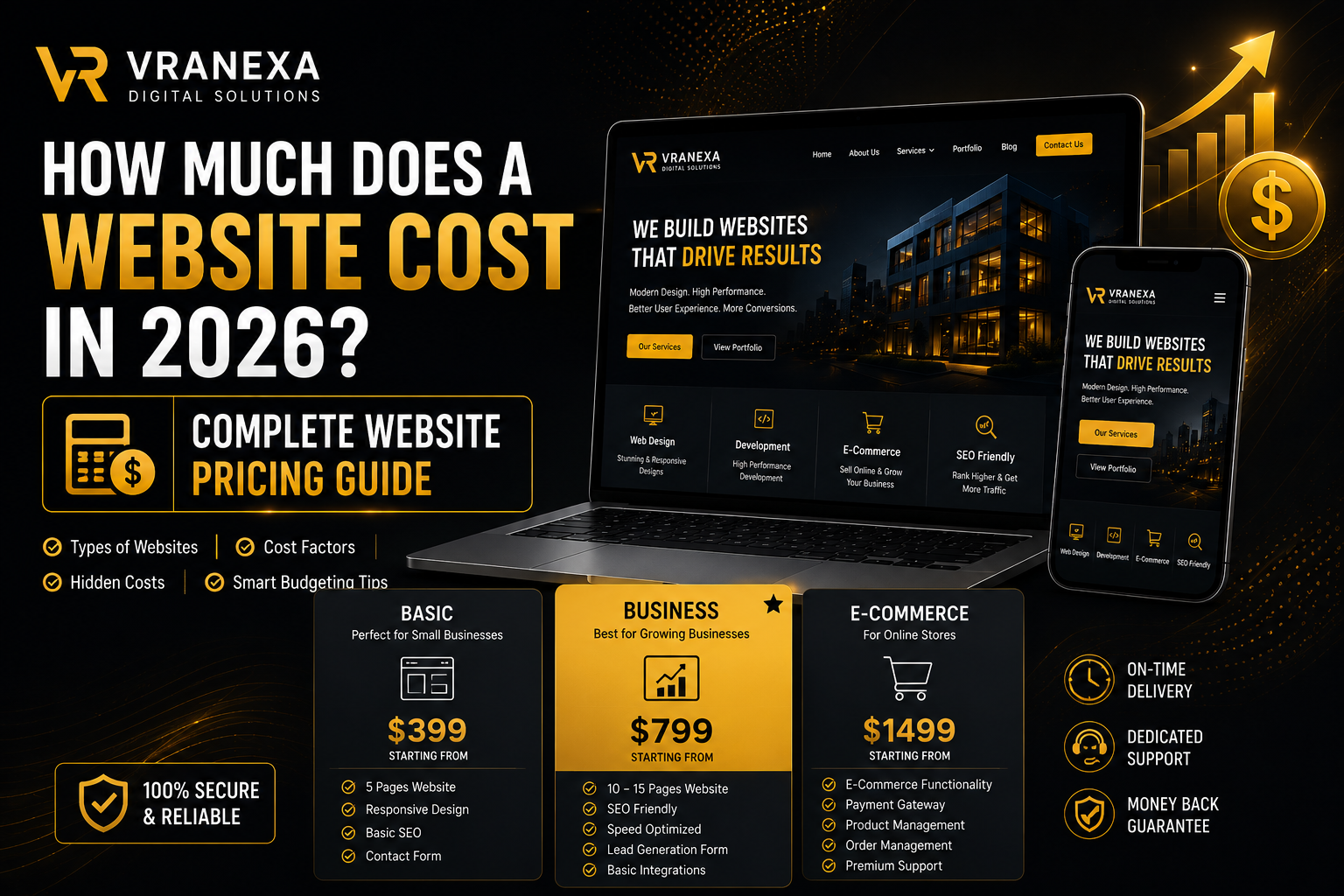
How Much Does a Website Cost in 2026?
“How much does a website cost?”
It sounds like a simple question, but there is no single price that applies to every website.
A five-page website for a local business and a custom e-commerce platform with hundreds of products are both websites, but their requirements, development time and complexity are completely different.
In 2026, businesses also expect more from their websites than simply having a few pages online.
A modern business website may need responsive design, strong performance, search engine optimization, conversion-focused layouts, security, analytics, integrations, content management and ongoing maintenance.
Because of these differences, website development costs can vary significantly.
Understanding what actually influences website pricing can help businesses set a realistic budget and avoid choosing a solution based purely on the cheapest quotation.
This guide explains the major factors that determine the cost of designing and developing a professional website in 2026.
Why Website Development Prices Vary So Much
You may request quotations from several web development companies and receive completely different prices.
One agency may quote a relatively small amount while another recommends a significantly larger budget.
This does not automatically mean one company is expensive and another is affordable.
They may be offering completely different levels of work.
Website pricing is influenced by factors such as the number of pages, design complexity, platform, functionality, custom development, content requirements, integrations, SEO requirements and ongoing support.
A website created from a basic template requires less development than a completely custom website designed around a company’s branding and customer journey.
Similarly, an informational business website requires less functionality than an online marketplace or membership platform.
Therefore, website cost should be evaluated against the actual scope of the project.
1. Type of Website
The type of website you need is one of the biggest factors affecting development cost.
Basic Business Website
A basic business website usually includes essential pages such as:
Home
About Us
Services
Contact
Privacy Policy
It is suitable for businesses that mainly need an online presence where customers can understand their services and contact them.
Although the functionality may be relatively straightforward, professional design, responsive layouts and good performance are still important.
Professional Corporate Website
Corporate websites generally contain more pages and require a stronger brand presentation.
They may include:
Multiple service pages
Case studies
Team profiles
Blog sections
Lead-generation forms
Testimonials
Locations
Resources
Custom landing pages
The larger content structure and additional design requirements usually increase development time.
E-Commerce Website
An e-commerce website introduces considerably more functionality.
Typical features include product catalogs, categories, product variants, shopping carts, checkout systems, payment gateways, customer accounts, order management, shipping options and inventory management.
Platforms such as Shopify and WooCommerce can provide much of this functionality, but professional configuration and customization are still required.
Large e-commerce projects may also require advanced filters, custom checkout features, subscriptions or integrations with external systems.
Custom Web Application
A custom web application is generally more expensive because it involves functionality created specifically for the business.
Examples include:
Customer portals
Booking systems
Dashboards
Marketplaces
Subscription platforms
Custom CRM systems
Learning platforms
Internal management systems
These projects require more planning, development and testing than traditional websites.
2. Custom Design vs Template Design
Another important pricing factor is how much of the website is designed specifically for your business.
Template-based websites start from an existing structure.
They can be a practical option for smaller businesses with limited requirements and budgets.
However, templates may restrict how much the website can be customized.
Custom web design starts with the company’s goals, audience, branding and content.
Designers create layouts specifically around these requirements.
This process may involve wireframes, UI design, UX planning, custom graphics and multiple design revisions.
Naturally, custom design requires more time.
But it can provide stronger brand differentiation and greater control over the customer experience.
The right option depends on your objectives rather than simply choosing whichever approach is cheaper.
3. Number of Website Pages
A website with five pages will generally require less work than a website containing fifty professionally designed pages.
Every page requires some combination of content organization, layout design, development, responsive optimization and testing.
However, page count alone does not determine cost.
For example, fifty blog posts using the same template require less design work than fifty unique landing pages.
This is why website developers usually evaluate both the number and complexity of page types.
Common website pages include:
Home
About
Services
Individual service pages
Portfolio
Case studies
Pricing
Blog
Contact
FAQ
Careers
Landing pages
Before requesting a website quotation, businesses should create an approximate sitemap.
This makes it easier for developers to estimate the project accurately.
4. Website Platform
The technology used to build the website can also influence pricing.
WordPress
WordPress remains a popular option for business websites because it provides flexible content management and a large ecosystem of themes and plugins.
It can be suitable for blogs, corporate websites, service businesses and many other projects.
The final cost depends heavily on how customized the website needs to be.
Shopify
Shopify is commonly used for e-commerce websites.
It provides important commerce infrastructure including products, checkout and order management.
Development costs vary depending on theme customization, custom sections, product complexity, integrations and required functionality.
WooCommerce
WooCommerce adds e-commerce functionality to WordPress.
It can be a flexible option when businesses want strong control over both website content and their online store.
However, complex WooCommerce websites may require additional optimization and development.
React and Next.js
React and Next.js are commonly used when businesses require highly customized front-end experiences or web applications.
These technologies provide developers with extensive flexibility but typically involve more custom development than standard website builders.
Choosing a platform should therefore be based on the project’s long-term requirements rather than trends alone.
5. Responsive Design
Your website needs to work across desktops, laptops, tablets and smartphones.
Responsive development involves more than making elements smaller.
Layouts may need to change significantly depending on the screen size.
For example, a desktop navigation menu may become a mobile menu.
A four-column service section may become a single-column layout.
Large headings need appropriate mobile typography.
Images must resize correctly.
Buttons must remain easy to tap.
Tables, forms, sliders and interactive elements also require testing.
Professional responsive development takes additional time, but it is an essential part of modern website development.
6. SEO Requirements
Search engine optimization can also influence the overall project cost.
A website that is simply launched online is different from one developed with SEO considerations from the beginning.
SEO-friendly development may include:
Logical heading structure
Clean URLs
Internal linking
Metadata implementation
Schema markup
Image optimization
XML sitemap configuration
Robots.txt configuration
Performance optimization
Mobile usability
Technical SEO checks
Keyword research and content optimization may be separate services depending on the project.
SEO should ideally be considered during development rather than being treated as something added after the website is completed.
7. Website Speed and Performance
Modern websites often contain large images, videos, animations, plugins and third-party scripts.
Without proper optimization, these elements can significantly affect performance.
Professional performance optimization may involve image compression, WebP or AVIF formats, caching, script optimization, lazy loading, database optimization, CDN configuration and reducing unnecessary resources.
Performance work becomes more complex on large websites and e-commerce stores.
A lightweight business website may require relatively simple optimization, while a large online store can require significantly more technical work.
8. E-Commerce Functionality
E-commerce pricing depends heavily on store complexity.
A small store selling twenty simple products requires less configuration than a business selling thousands of products with multiple variations.
Cost can increase when stores require features such as:
Advanced product filtering
Subscriptions
Multi-currency support
Wholesale pricing
Custom product options
Abandoned cart systems
Advanced shipping rules
ERP integration
Custom payment methods
Marketplace functionality
When planning an e-commerce website, businesses should document these requirements before development begins.
9. Third-Party Integrations
Many modern websites need to communicate with external services.
Examples include:
CRM software
Email marketing platforms
Payment gateways
Accounting systems
Booking platforms
WhatsApp integrations
Analytics tools
Marketing automation
Shipping providers
External APIs
Some integrations are simple because official plugins or applications already exist.
Others require custom API development.
Custom integrations usually increase both development and testing requirements.
10. Content Creation
A website cannot communicate effectively without good content.
Businesses sometimes budget only for development and forget about copywriting, photography, graphics and videos.
Professional content creation may include website copywriting, SEO articles, custom illustrations, product photography, promotional videos and branded graphics.
If a business already has high-quality content available, this part of the budget may be smaller.
However, poorly written placeholder content can reduce the effectiveness of even an excellent website design.
11. Website Maintenance
Website costs do not necessarily end when development is completed.
Most professional websites require ongoing maintenance.
Maintenance may include software updates, security monitoring, backups, performance checks, bug fixes and content updates.
WordPress websites, for example, may require regular updates for WordPress itself, themes and plugins.
E-commerce websites may require even more attention because they directly support transactions and customer data.
Businesses should therefore consider ongoing maintenance when calculating their total website budget.
12. Domain and Hosting Costs
A domain name and hosting are separate from website design in many projects.
Your domain is the address visitors use to access your website.
Hosting provides the server infrastructure that makes the website available online.
Hosting prices vary depending on traffic, performance, storage, server resources, backups and support.
Very cheap hosting can sometimes create performance or reliability problems.
For business-critical websites, hosting should be selected based on actual requirements rather than price alone.
Cheap Website vs Professional Website
A cheap website may appear attractive initially.
However, the real question is whether it achieves the business objective.
If a low-cost website loads slowly, looks unprofessional, performs poorly on mobile devices and fails to generate enquiries, the money saved during development may not matter.
On the other hand, paying a large amount does not automatically guarantee a successful website.
The important factors are strategy, execution and measurable business value.
A professional website should provide a balance between design, usability, performance, SEO and conversion.
How Should You Set Your Website Budget?
Start by identifying what the website needs to achieve.
Do you simply need an online presence?
Do you need qualified leads?
Do you want customers to purchase products online?
Do you require appointment bookings?
Does the website need to connect with existing business software?
Once the objective is clear, identify the features required to achieve it.
Separate essential features from optional enhancements.
This allows you to create a realistic first version without unnecessarily increasing project complexity.
Questions to Ask Before Hiring a Web Development Company
Before selecting a web development company, ask what exactly is included in the quotation.
Find out whether the project includes responsive development, basic SEO setup, performance optimization, content upload, contact forms, analytics, security configuration, revisions and post-launch support.
Also ask who owns the website after completion.
Your business should clearly understand ownership of the domain, hosting, website files and administrative accounts.
A detailed scope protects both the client and development company from misunderstandings later.
Is a Professional Website Worth the Investment?
For many businesses, the website is one of the first interactions a potential customer has with the brand.
Customers may discover the business through Google, advertisements, social media, referrals or offline marketing.
Regardless of how they find you, many will eventually visit your website before making a decision.
That makes your website an important part of your sales and marketing infrastructure.
A well-designed website can help communicate credibility, explain your services, showcase previous work and make it easier for customers to contact or purchase from you.
The value of a website should therefore be evaluated based on what it contributes to the business over time.
Conclusion
The cost of building a website in 2026 depends on much more than the number of pages.
Website type, custom design, technology, functionality, responsive development, SEO, performance, integrations, content and maintenance all influence the final investment.
Instead of searching only for the cheapest website package, businesses should first determine what they need their website to accomplish.
A website designed around clear business objectives can become a long-term digital asset rather than simply another expense.
At Vranexa, we focus on building modern, responsive, performance-focused and conversion-oriented digital experiences for businesses that want more from their online presence.
Ready to build your next website?
Let’s build your high-converting website.
Get a fast, responsive and SEO-ready website designed for real business growth.