

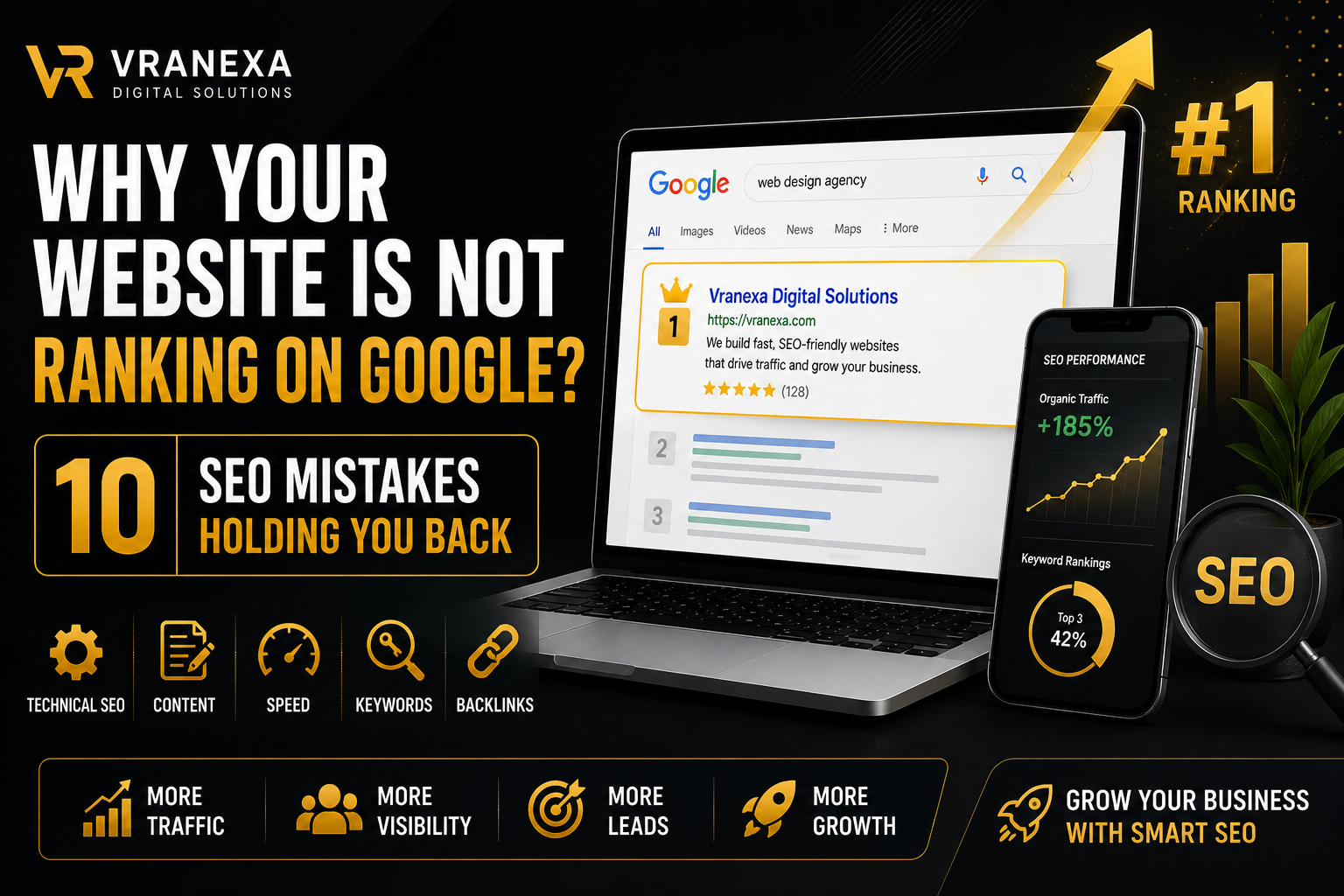
Why Your Website Is Not Ranking on Google: 10 SEO Mistakes to Fix in 2026
You have built a professional website.
Your services are clearly listed, your contact information is available, and your business is ready to serve customers.
But there is one major problem:
People cannot find your website on Google.
For many businesses, this can be frustrating. You may search for your main services and see competitors appearing on the first page while your own website is nowhere to be found.
The immediate question becomes:
“Why is my website not ranking on Google?”
There is rarely one simple answer.
Search visibility depends on many factors, including technical SEO, content quality, website speed, search intent, competition, internal linking, authority and overall user experience.
A website can look excellent visually while still having a weak SEO foundation.
Understanding the problems that may be limiting your visibility is the first step toward improving it.
Here are ten common SEO mistakes that can prevent business websites from performing well in search results.
1. You Are Targeting the Wrong Keywords
Keyword selection is one of the foundations of SEO.
A common mistake businesses make is trying to rank for extremely broad keywords.
For example, a new web development company may try to rank immediately for:
“Web Development”
This keyword may be highly competitive and extremely broad.
A more targeted approach might focus on searches such as:
Professional WordPress Development Services
Shopify Website Development Company
Website Design Services for Small Businesses
E-commerce Website Development Agency
These phrases may align more closely with the services customers are actually looking for.
Keyword research is not simply about finding terms with the highest search volume.
The goal is to identify searches that combine relevance, intent and realistic ranking opportunities.
A keyword that brings ten highly relevant potential customers can be more valuable than one generating hundreds of visitors who have no intention of purchasing your service.
2. Your Website Content Is Too Thin
Google needs enough information to understand what a page is about.
A service page containing only a heading, one image and two short paragraphs may not provide enough context.
Strong service pages should answer important customer questions.
For example, a web development page could explain what the service includes, which platforms are supported, how the development process works, what benefits customers receive, frequently asked questions and how potential clients can get started.
This does not mean every page needs thousands of words.
Content should be as detailed as necessary to satisfy the visitor’s intent.
Writing unnecessary paragraphs purely to increase word count rarely improves the user experience.
Instead, focus on usefulness.
Ask:
What would someone searching for this service genuinely want to know?
Then answer those questions clearly.
3. Your Search Intent Does Not Match the Keyword
Search intent describes what a person actually wants when they enter a query into Google.
Understanding this is critical.
Someone searching:
“What is SEO?”
is probably looking for information.
Someone searching:
“SEO agency for small business”
may be looking for a service provider.
Someone searching:
“SEO pricing”
may be comparing costs.
All three searches relate to SEO, but their intentions are different.
If your page does not match the expected intent, ranking can become more difficult.
Before creating a page, understand what type of content people expect to find for the target query.
This could be a blog article, service page, product page, comparison, guide or landing page.
Content should be created around that expectation.
4. Your Website Has Technical SEO Problems
Even excellent content can struggle when the website has technical problems.
Technical SEO helps search engines access, understand and index your website.
Common issues can include broken internal links, incorrect canonical tags, duplicate pages, indexing problems, missing sitemaps, redirect chains and poorly structured URLs.
Businesses sometimes focus heavily on keywords while ignoring these underlying problems.
A technical SEO audit can identify issues that may be limiting search visibility.
Some problems are relatively simple to fix.
Others may require changes to the website architecture or development.
The important point is that SEO is not only a content activity.
The technical foundation matters too.
5. Your Website Is Too Slow
Website performance affects both visitors and overall website quality.
Large images, excessive plugins, unnecessary JavaScript, heavy animations and poor hosting can make pages slow.
Imagine finding exactly the service you need on Google.
You click the result.
The website begins loading.
Several seconds pass.
The page still has not become usable.
Many visitors will simply return to the search results.
Improving website performance can involve compressing images, using modern formats, implementing caching, removing unnecessary plugins, optimizing code, reducing third-party scripts and using suitable hosting.
Performance optimization should ideally be considered during website development rather than added only after problems appear.
6. Your Website Is Not Properly Optimized for Mobile
People regularly use smartphones to search for businesses, services and products.
A website that works beautifully on desktop but poorly on mobile creates a weak experience for a significant portion of visitors.
Common mobile problems include tiny text, oversized headings, horizontal scrolling, buttons that are difficult to tap, images being cropped incorrectly and navigation menus that do not function properly.
Responsive design should adapt the entire experience to different screen sizes.
Important content should remain readable.
Calls to action should remain accessible.
Forms should remain easy to complete.
Images should resize correctly.
A strong mobile experience benefits both users and your overall digital presence.
7. Your On-Page SEO Is Weak
On-page SEO helps search engines and users understand individual pages.
Important elements include the page title, meta description, H1 heading, H2 and H3 structure, URL, image alt text, internal links and page content.
For example, a service page should usually have one clear primary H1 describing the service.
Supporting sections can then use H2 and H3 headings to organize the information.
Do not force the target keyword into every heading and paragraph.
Keyword stuffing creates unnatural content and does not provide a good reading experience.
Use relevant terminology naturally.
Your priority should remain clear communication.
8. Your Internal Linking Strategy Is Poor
Internal links connect pages within your own website.
They help visitors discover related information and help search engines understand relationships between pages.
Suppose Vranexa publishes an article about website redesign.
That article could naturally link to related resources about website development costs, conversion optimization, SEO-friendly design and web development services.
Those pages could also link back where appropriate.
This creates a connected content structure rather than a collection of isolated pages.
Internal links should be useful and contextual.
Avoid adding links simply because you want to insert a keyword.
Ask whether the linked page genuinely helps the reader continue their journey.
9. Your Website Lacks Authority and Quality Backlinks
Backlinks are links from other websites pointing to yours.
They can act as signals that other websites consider your content or business worth referencing.
However, backlink quality matters considerably.
Buying hundreds of low-quality links or placing links across unrelated websites can create more problems than benefits.
A stronger strategy focuses on earning relevant links.
This can happen through original research, useful resources, industry partnerships, digital PR, guest contributions, business directories and genuinely valuable content.
For local businesses, accurate business listings and relevant local citations can also support online visibility.
Building authority takes time.
There is rarely a legitimate shortcut.
10. You Expect SEO Results Too Quickly
SEO is generally a long-term strategy.
A website launched today should not automatically be expected to outrank established competitors tomorrow.
Search engines need time to discover pages, understand content and evaluate websites within competitive search results.
Businesses also need time to build useful content, improve their website, earn authority and collect performance data.
This does not mean every SEO project takes the same amount of time.
Results depend on competition, website history, content quality, technical condition, target keywords and many other factors.
The important lesson is to evaluate SEO as an ongoing process rather than a one-time task.
How Can You Improve Your Google Rankings?
Start with a complete evaluation of your website.
Check whether important pages are indexed.
Review your keyword targeting.
Evaluate page content.
Test website performance.
Check the mobile experience.
Review heading structures and metadata.
Find broken links.
Improve internal linking.
Then compare your website against competitors already ranking for the searches you want to target.
Do not simply copy them.
Instead, identify what information users need and determine how your website can provide a better experience.
SEO improvements often come from fixing many small problems rather than discovering one secret technique.
Build Topic Authority With Helpful Content
Blogging can support an SEO strategy when content is created around real customer questions.
For example, a web development agency could build content around topics such as:
How Much Does a Website Cost?
Why Is My Website Not Generating Leads?
When Should I Redesign My Website?
WordPress vs Shopify
How Long Does Website Development Take?
How to Improve Website Speed
Each article addresses a different customer question while supporting the broader topic of website development.
Over time, this creates a useful knowledge base for potential customers.
More importantly, these articles can naturally connect to relevant service pages.
SEO and Website Design Should Work Together
SEO should not begin only after a website has been designed.
Website architecture, navigation, page structure, mobile responsiveness and performance all influence the final digital experience.
This is why SEO and web development should work together.
Developers need to understand technical SEO requirements.
Designers need to consider usability.
Content creators need to understand search intent.
SEO specialists need to understand how pages are structured.
When these areas operate separately, problems often appear later.
When they work together, the website can be built on a stronger foundation from the beginning.
Should You Focus on SEO or Paid Advertising?
SEO and paid advertising solve different problems.
Paid advertising can provide immediate visibility while campaigns are active.
SEO focuses on building organic visibility over time.
Many businesses benefit from using both.
Paid campaigns can generate leads while organic visibility is developing.
SEO content can continue attracting relevant searches over the longer term.
The correct balance depends on your budget, competition and growth objectives.
Rather than asking which channel is universally better, ask which combination makes sense for your particular business.
Measure SEO Performance Correctly
Do not evaluate SEO only by searching your business keywords manually.
Rankings can change based on location, device, personalization and competition.
Instead, monitor a combination of metrics.
These can include organic clicks, impressions, search queries, landing page traffic, conversions and qualified enquiries.
Traffic alone is not enough.
If organic traffic increases significantly but generates no relevant business opportunities, the strategy may be attracting the wrong audience.
For a business website, SEO should ultimately support meaningful business objectives.
Conclusion
If your website is not ranking on Google, do not assume that simply adding more keywords will solve the problem.
Search performance depends on a combination of relevant content, technical quality, user experience, website performance, mobile responsiveness, internal linking and authority.
Start by identifying the actual weaknesses.
Fix technical problems.
Improve important service pages.
Create genuinely useful content.
Strengthen internal linking.
Improve website performance.
Then continue monitoring and refining the strategy.
SEO takes time, but a strong foundation can help your website become a consistent source of relevant organic traffic and business opportunities.
At Vranexa, our approach combines web development, performance, SEO-friendly architecture and conversion-focused design to help businesses build a stronger digital presence.
Want More Customers to Find Your Business on Google?
Build a faster, SEO-ready website designed for long-term growth.
Let’s build your high-converting website.
Get a fast, responsive and SEO-ready website designed for real business growth.